In der modernen Kunst steht das Quadrat für die paradigmatische Form, die jegliche Gegenständlichkeit ablehnt und den Fokus auf das autonome Kunstwerk legt.
In Kasimir Malewitschs erstmals 1915 ausgestellten „Schwarzem Quadrat“ manifestiert es sich als radikaler Bruch mit der mimetischen Tradition sowie als programmatische Setzung einer neuen, rein geistigen Bildsprache. Seitdem ist das Quadrat zum Signum der Moderne geworden, das gleichermaßen formale Strenge wie utopisches Potenzial verkörpert.
Für zeitgenössische Künstler stellt das Quadrat eine Herausforderung dar. Kann es gelingen, dieser radikalen Reduktion und formalen Klarheit in einer von Bilderfluten geprägten Gegenwart neue Aspekte abzugewinnen?
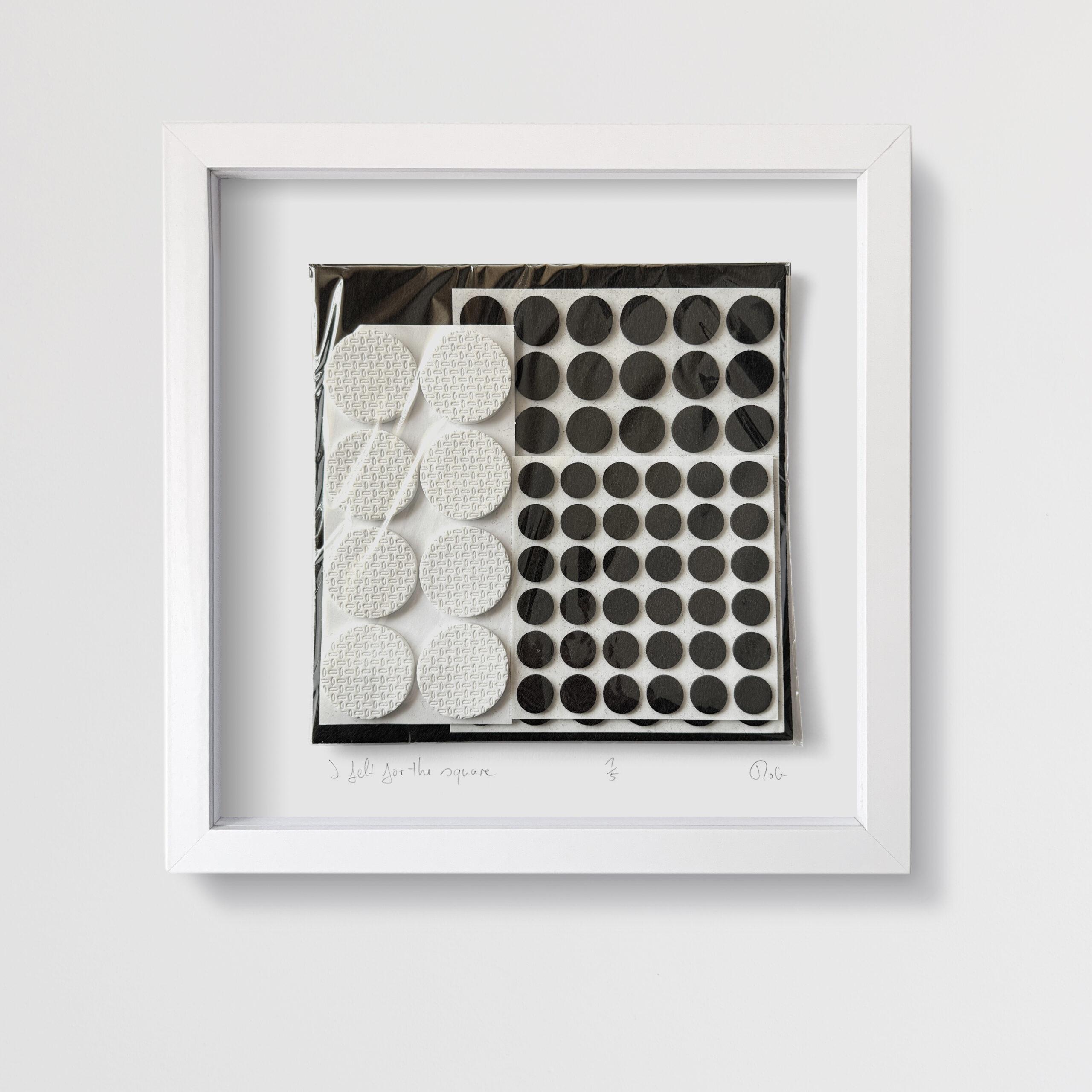
Auf den ersten Blick entzieht sich der deutsch-kroatische Künstler Rob R. Ros mit der Arbeit „I felt for the square“ einer Antwort, indem er in der Tradition Marcel Duchamps einen alltäglichen Industrie- oder Gebrauchsgegenstand – in diesem Fall selbstklebende Filzgleiter – ästhetisch auflädt und zum Kunstwerk erklärt.
Wie Malewitschs Quadrat markieren Duchamps Readymades einen fundamentalen Paradigmenwechsel, indem sie die Idee und den Kontext über die handwerkliche Herstellung stellten und damit die Grenzen des Kunstbegriffs radikal erweiterten.
Kommt man der Intention dieses Multiples näher, wenn man bemerkt, dass die kreisrunden Filzgleiter in einem seltsamen Kontrast zum mehrdeutigen Titel „I felt for the square“ stehen und dabei eventuell die Op-Art eines Victor Vasarely zitieren? Ist man bei der Suche nach einem vermeintlichen Sinn eventuell bereits in eine semantische Falle getappt?
Vielleicht liegt der Charme dieser Arbeit einfach im intellektuell-spielerischen und (selbst)ironischen Umgang mit Referenzpunkten der modernen Kunst.
Robère Scholz Galerie r8m
I felt for the square
On the multiple by artist Rob R. Ros
In modern art, the square represents the paradigmatic form that rejects all representationalism and focuses on the autonomous work of art.
In Kasimir Malevich’s ‘Black Square,’ first exhibited in 1915, it manifests itself as a radical break with the mimetic tradition and as a programmatic establishment of a new, purely spiritual visual language. Since then, the square has become the sign of modernism, embodying both formal rigour and utopian potential.
The square poses a challenge for contemporary artists. Is it possible to derive new aspects from this radical reduction and formal clarity in a present characterised by a flood of images?
At first glance, German-Croatian artist Rob R. Ros evades an answer with his work ‘I felt for the square’ by following in the tradition of Marcel Duchamp, aesthetically charging an everyday industrial or utility object – in this case, self-adhesive felt glides – and declaring it a work of art.
Like Malevich’s square, Duchamp's readymades mark a fundamental paradigm shift by placing the idea and context above craftsmanship, thereby radically expanding the boundaries of the concept of art.
Does one come closer to understanding the intention of this multiple when one notices that the circular felt pads stand in strange contrast to the ambiguous title ‘I felt for the square’ and possibly reference the op art of Victor Vasarely? In searching for a supposed meaning, have we perhaps already fallen into a semantic trap? Perhaps the charm of this work lies simply in its intellectually playful and (self-)ironic treatment of reference points in modern art.
Robère Scholz Gallery r8m
Diese Website benutzt Cookies. Wenn du die Website weiter nutzt, gehen wir von deinem Einverständnis aus.